


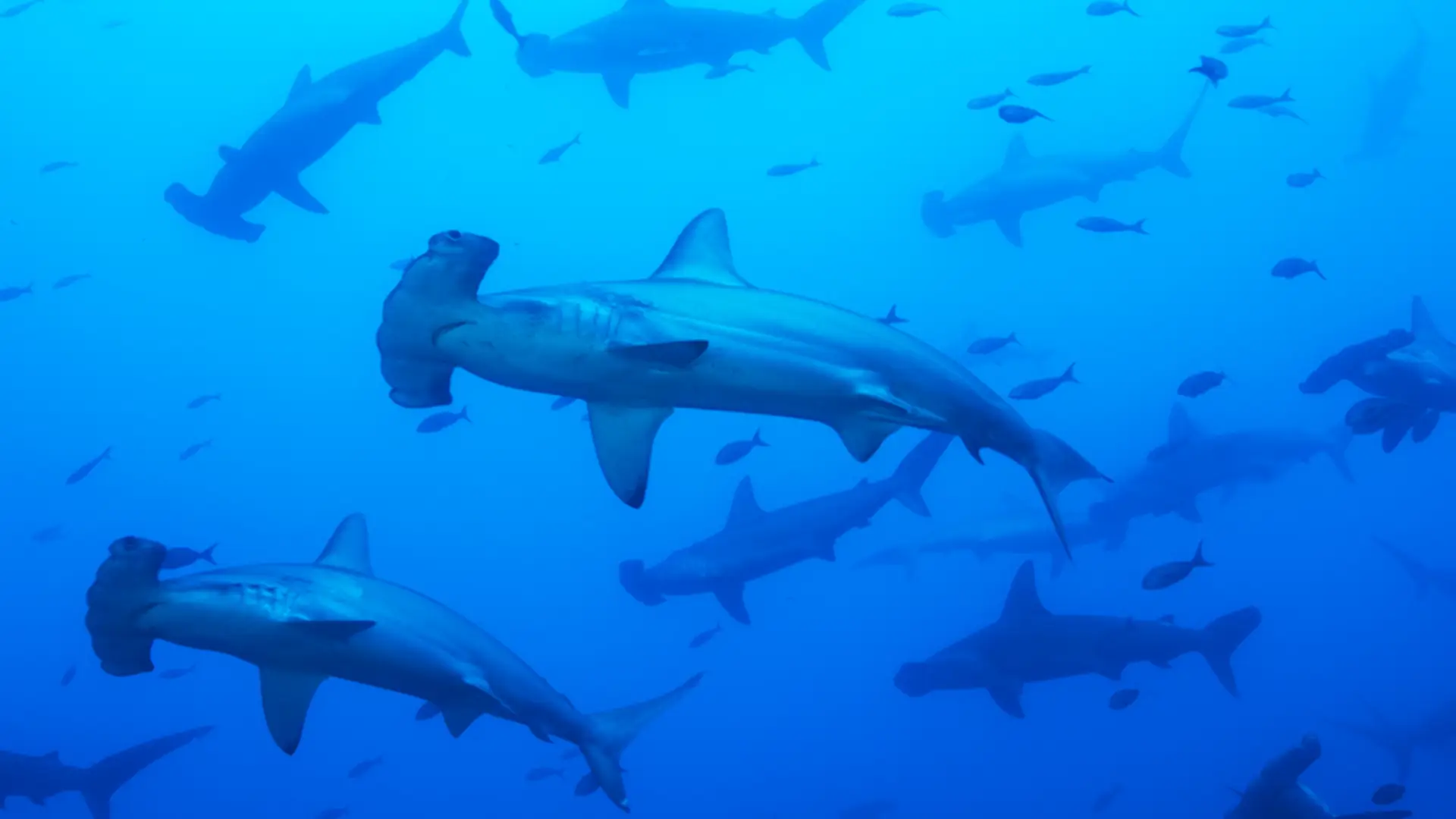
Hammerhead shark
diving in the
Red Sea
Where they are, when they school, how deep they hold, and which single itinerary gives you two full days at Daedalus Reef — the most reliable hammerhead site reachable from Europe.
The most accessible hammerhead diving on earth.
Scalloped hammerhead sharks school in a handful of places globally — the Galápagos, Cocos Island, parts of Southeast Asia. All of them require long-haul flights, expensive permits, and specialist operators that are often fully booked months in advance. The Red Sea is the exception. Direct flights from London, Paris, Amsterdam, Frankfurt and Milan reach Marsa Alam or Hurghada in under five hours. The liveaboards that access Daedalus Reef — the primary hammerhead site — are competitively priced by global standards. And the sharks are there from May through October without fail.
What makes Daedalus different from most hammerhead destinations is behaviour. The scalloped hammerheads at Daedalus are accustomed to divers. They do not flee on approach the way they do at more diver-pressured sites. Schools circle the north plateau in formation, often at 20–30m depth, and individual sharks have been documented making close passes at recreational diving depth. It is not guaranteed — no wildlife encounter is — but it is as reliable as hammerhead diving gets outside the remote Pacific.
The other factor is the combination of species. On any given Daedalus dive in peak season, you are likely to share the water with scalloped hammerheads, oceanic whitetip sharks, grey reef sharks, and potentially threshers. No other destination reachable from Europe concentrates this range of apex predators in a single offshore reef system.
Scalloped hammerhead — what you need to know.
Before diving with any shark species, understanding its biology and behaviour removes the guesswork and makes the encounter safer and more rewarding. Here is what matters at Daedalus.
The scalloped hammerhead is named for the scalloped front edge of its distinctive cephalofoil — the hammer-shaped head that gives the species its name and defines its sensory capability. The wide-set eyes give near-360° vision and the expanded surface area of the head houses a dense network of electroreceptors, allowing the shark to detect the electrical fields of prey buried in sand. Females grow to 4m and typically live longer and grow larger than males (1.5–2m). At Daedalus Reef, the sharks seen in schools are predominantly females.
“A school of 25+ hammerheads circling in formation at 25m. I’ve been diving 20 years. Nothing prepared me for the scale of it.”
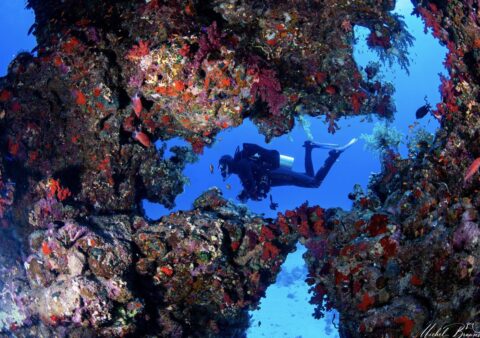
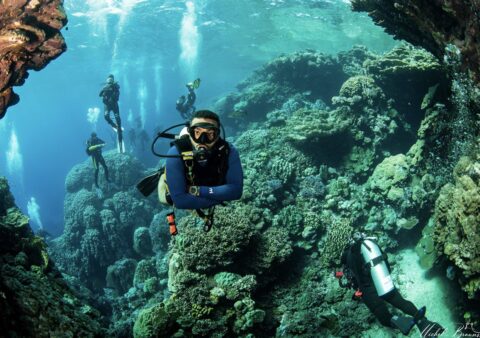
Daedalus Reef — Abu Kizan.
80 kilometres offshore from Marsa Alam. No day boats. No road. A lighthouse built on a man-made platform above a coral atoll rising from 800 metres of open ocean. This is where you dive if you want hammerheads in the Red Sea.
The hammerhead calendar.
Hammerheads are present at Daedalus year-round — but depth, frequency and schooling behaviour change month by month. This is what the water delivers.
May and June are the consensus peak months for schooling behaviour at Daedalus. The sharks move into shallower water — 20–30m — and form the tight circular schools that photographers come for. Water temperature is comfortable at 26–27°C and a 3mm wetsuit covers most divers. This is also when the hammerheads are reportedly most tolerant of diver presence.
July through September keeps strong hammerhead numbers but the sharks hold deeper as the water warms. Encounters at 30–40m on the drop-off are common. This window overlaps with growing oceanic whitetip presence. A 3mm shorty is enough in July–August; some divers wear a skin suit. JP Marine’s Pelagic Trail runs through this window and June–September is when the two-itinerary combination of Daedalus hammerheads plus Sataya dolphins is at its most productive.
October onwards — oceanic whitetip sharks build toward their peak (October–January). Individual hammerhead encounters continue at Daedalus, though schooling is less predictable. A 5mm wetsuit becomes advisable from November.
Two days at Daedalus. One week. One boat.
Most Red Sea itineraries spend a single day at Daedalus. JP Marine’s Pelagic Trail gives you two full diving days on the reef — doubling your hammerhead encounter probability — plus wild dolphins at Sataya and the cave systems of Fury Shoal.
Trail
-
Daedalus Reef — Day 1North plateau hammerheads · oceanic whitetips · lighthouse visit · 3–4 dives
-
Daedalus Reef — Day 2Second full day · morning hours are peak for schooling · deeper encounters on drop-off
-
Sataya · Dolphin HouseResident spinner dolphin pod · 100+ individuals · snorkel & reef scuba
-
Fury Shoal cave systemsClaudia, Malahy, Abu Galawa · coral tunnels · night dive
-
Elphinstone ReefOceanic whitetips · dramatic wall dive · hammerheads possible north plateau
-
Marsa Alam warm-up reefsDays 1–2 · coral gardens · turtles · check dives before offshore sites
You are diving remote water.
Daedalus Reef is 80km from the Egyptian coast. The nearest decompression chamber is in Marsa Alam — several hours away by sea. Remote diving requires an operator with genuine emergency preparedness, not a printed checklist. JP Marine has been operating southern Red Sea routes since 1999. These are the actual numbers.
Before you book.
The hammerheads
are at Daedalus.
Two days on the reef. 18–21 dives total. Wild dolphins at Sataya. Up to 5 shark species in one week. Open Water divers welcome. Direct booking — no agency fees.